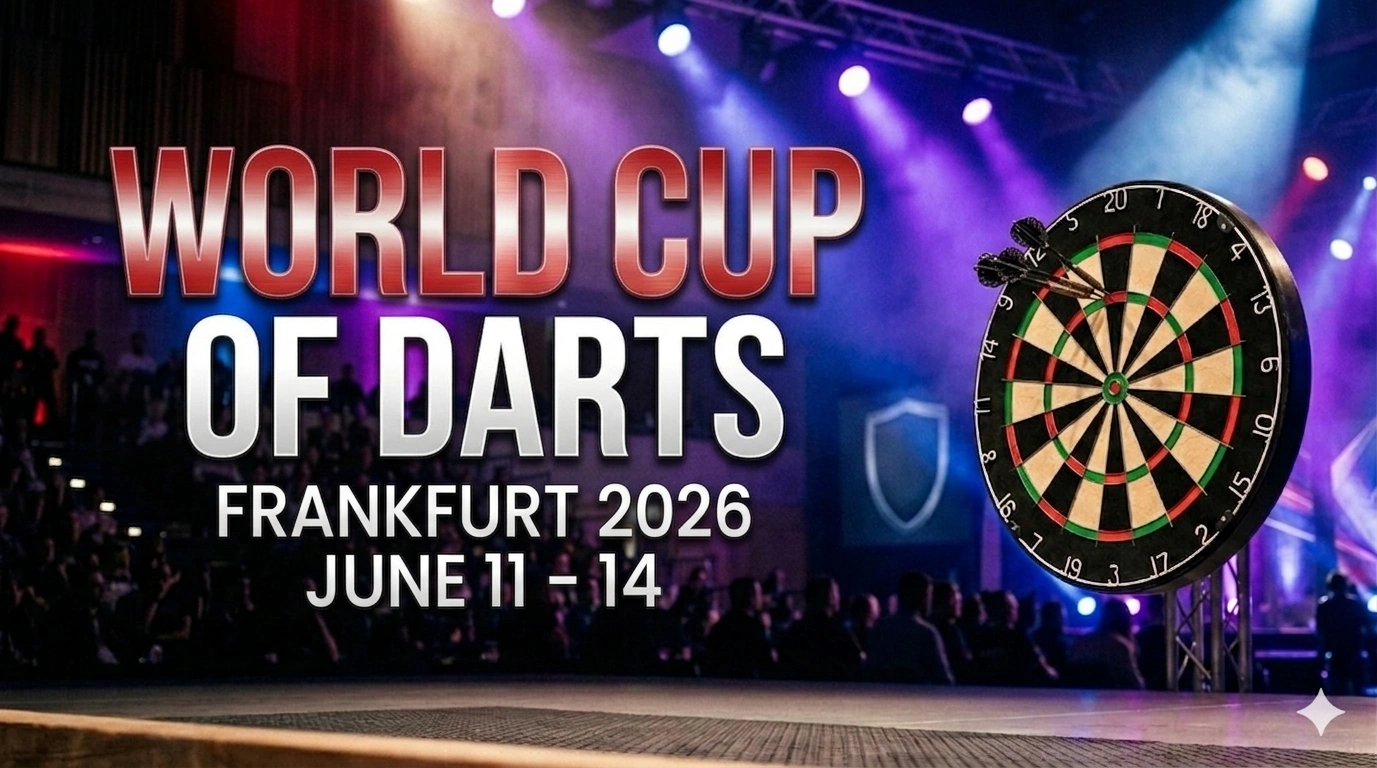
From 11 to 14 June 2026, Frankfurt’s Eissporthalle will host the World Cup of Darts, the only major PDC tournament where nations compete in a pairs format.
A unique event on the calendar: no individual rankings are at stake, but a rare collective pressure that regularly produces surprises. In 2025, Josh Rock and Daryl Gurney secured Northern Ireland’s first-ever title. In 2026, 40 nations will be vying for the crown.
Here is everything you need to know: the exact schedule, how the format works, the qualified nations, the full list of winners, ticketing and TV coverage.
13 June 2026 update: the Last 16 line-up is set
The group stage is now complete and Saturday’s programme has been confirmed in Frankfurt. The Last 16 will be played across two four-match sessions, with Latvia v France in the afternoon and Northern Ireland v Belgium in the evening.
| Session | Time | Ties |
|---|---|---|
| Afternoon | 12pm BST | Republic of Ireland v Poland; Latvia v France; Scotland v Norway; Wales v USA |
| Evening | 6pm BST | Northern Ireland v Belgium; Germany v Czechia; England v Spain; Netherlands v Sweden |
From this stage onwards, all matches are played over a best of 15 legs format. For live coverage, PDCTV remains the simplest option in most territories, while Sky Sports holds the UK rights and Sport1 / DAZN cover Germany, Austria and Switzerland.
What to know from the 2026 draw
Update – 10 June 2026: the full draw and detailed schedule are now confirmed for the 2026 World Cup of Darts. The four seeded nations England, the Netherlands, Northern Ireland and Scotland will enter directly in the last 16, while the twelve groups of three get the tournament underway in Frankfurt from Thursday evening, 11 June.
| Session | Time | What is scheduled |
|---|---|---|
| Thursday 11 June | 19:00 | Opening group-stage matches |
| Friday 12 June | 12:00 | Second wave of group-stage matches |
| Friday 12 June | 19:00 | Final group-stage matches |
| Saturday 13 June | 13:00 and 19:00 | Round-of-16 ties |
| Sunday 14 June | 13:00 then 19:00 | Quarter-finals, semi-finals and final |
June 11 update: the favourites, the pairs to watch and the last-minute change
The 2026 World Cup of Darts begins this Thursday, June 11 in Frankfurt, with 40 nations gathered at the Eissporthalle until Sunday, June 14. On the eve of the opening night, the PDC’s official preview confirms a very strong field, but also a significant change to the group line-up: Gibraltar replaces Uganda after the Ugandan representatives’ visa applications were unsuccessful.
This update does not change the tournament’s overall format, but it does alter the balance of the Republic of Ireland’s group. William O’Connor and Mickey Mansell were due to face Singapore and Uganda; they will now take on Singapore and Gibraltar, represented by Craig Galliano and Justin Hewitt. Uganda had been set to field Patrick Ocheng and Juma Said, but neither player was granted a visa for Germany, and their appeal was rejected. The PDC also stated that Malawi, runners-up in the African qualifier, were unable to collect their visas in time, which opened the door for Gibraltar.
 World Cup of Darts 2026 illustration in Frankfurt
As for the favourites, the four nations seeded straight through to the last 16 remain the main reference points in the draw: England, the Netherlands, Northern Ireland and Scotland. They avoid the group stage, which gives them an obvious advantage in terms of energy management, but also brings immediate pressure: their tournament will begin with a straight knockout match.
England will inevitably draw attention. Luke Littler and Luke Humphries are the number one seeds, bringing a rare blend of scoring power, consistency and composure on the doubles. After an early exit last year, this pairing arrives with a point to prove. On paper, they are the most impressive team in the field, but the World Cup remains a very specific format: partnership and balance matter just as much as individual averages.
Defending champions Josh Rock and Daryl Gurney carry Northern Ireland’s crown into the tournament. Their status is different from England’s: less expectation of domination, but valuable recent experience in this team format. Rock brings explosiveness, Gurney brings solidity and big-stage know-how. If they rediscover the same balance that took them to the title, they will remain very difficult to knock out.
The Netherlands will also be a team to watch closely, with Michael van Gerwen paired with Gian van Veen. Van Gerwen remains one of the most intimidating players on the circuit, while Van Veen brings fresh energy. The main question is whether the duo can find their rhythm quickly, because the pressure around a Dutch team is always high in this competition.
In the groups, the headline names are not the only ones worth watching. Germany, backed by the Frankfurt crowd, begin their campaign against the Philippines and New Zealand. It is a dangerous group: home advantage can lift a team, but it can also tighten arms when it is time to finish the job. Belgium must navigate a group featuring Hong Kong and Slovenia, two opponents who should not be underestimated in short-format matches.
Wales, with Jonny Clayton and Nick Kenny, will also need to take the group stage seriously against Lithuania and Thailand. Clayton offers real experience, but Kenny’s level will be important if Wales are to turn their status into qualification. In this format, a nation that looks favoured on paper can quickly come under pressure if the opening match becomes tight.
Uganda’s replacement by Gibraltar also adds a practical angle to follow. Gibraltar enter the draw late, but with two players used to representing their territory. For the Republic of Ireland, the trap is clear: they must not treat this change as an automatic easing of the group. At the World Cup, reputational gaps can close quickly once the doubles become decisive.
Groups and ties to watch
| Group | Teams | Opening match |
|---|---|---|
| A | Germany, Philippines, New Zealand | Germany vs Philippines |
| C | Wales, Lithuania, Thailand | Wales vs Lithuania |
| G | Australia, United States, Canada | Australia vs United States |
| H | Czech Republic, India, Denmark | Czech Republic vs India |
| I | Austria, China, France | Austria vs China |
The draw already sharpens several talking points before the opening session. Wales arrive without Gerwyn Price, which inevitably changes the way the tournament is viewed around Jonny Clayton and Nick Kenny. England, with Luke Littler and Luke Humphries, start as the logical favourites, while Germany open at home in front of their own crowd and France now know they must come through Group I against Austria and China.
Dates and venue: Frankfurt, 11–14 June 2026
The tournament kicks off on Thursday 11 June 2026. The group stage takes place over the first two days, spread across three sessions on Thursday 11 and Friday 12 June. Saturday 13 June is dedicated to the second round, featuring the round of 16. Sunday 14 June is the full final day: the quarter-finals, semi-finals and final are played back-to-back, and the champion is crowned in the evening.
Since 2022, the Eissporthalle in Frankfurt am Main has been the tournament’s permanent home. This will be the fifth consecutive edition held at this venue. However, the tournament has changed cities several times since its inception: it began in 2010 in England, at Houghton-le-Spring, before moving to Hamburg in 2012 for three editions. Frankfurt hosted the tournament for the first time between 2015 and 2018, before stints in Hamburg, Salzburg and Jena, linked in particular to the COVID-19 pandemic.
Nations players list
Pays | Joueur 1 | Joueur 2 |
|---|---|---|
England | ||
Netherlands | ||
Northern Ireland | Josh Rock | Daryl Gurney |
Scotland | ||
Germany | ||
Belgium | ||
Wales | ||
Republic of Ireland | ||
Poland | ||
Sweden | ||
Australia | ||
Czechia | ||
Austria | ||
Latvia | Valters Melderis | |
Croatia | ||
Finland | ||
Canada | David Cameron | |
China | Qingyu Zhan | |
Denmark | Andreas Toft Jorgensen | |
France | ||
Hong Kong | ||
Hungary | Patrik Kovacs | |
India | Ankit Goenka | |
Italy | Michele Turetta | |
Japan | ||
Lithuania | ||
Mongolia | Altantulkhuur Myagmarsuren | Ganzorig Lkhagvasuren |
New Zealand | Jonny Tata | |
Norway | Kent Jøran Sivertsen | |
Philippines | ||
Portugal | Jose de Sousa | |
Singapore | Phuay Wey Tan | |
Slovenia | Stefano Bozicek | |
South Africa | Graham Filby | Devon Petersen |
Spain | ||
Switzerland | ||
Thailand | Sarayut Ouamumpa | Sowaris Rodman |
Trinidad and Tobago | Joshua Balfour | Joshua Balfour |
Uganda | Patrick Ocheng | Juma Said |
USA | Adam Sevada |
Format and qualification: the logic of national pairs
The Darts World Cup operates on a principle unique to the PDC circuit: each nation fields a pair of players, and all matches from the group stage through to the final are contested in pairs. This exclusive pairs format has been in place since the 2023 overhaul, which abolished the singles matches that previously existed.
Group stage
A total of 40 nations take part. The top four nations in the combined PDC Order of Merit ranking of their two players are directly seeded and exempt from the group stage. The remaining 36 nations are divided into twelve groups of three teams. Group matches are played as best-of-7 legs. Only the winner of each group progresses. The 12 qualifiers join the four seeded nations to form a 16-nation draw.
Knockout stage
From the second round onwards, the format becomes more intense. The round of 16, quarter-finals and semi-finals are played as best-of-15 legs. The final switches to a best-of-19 legs format, guaranteeing a long and tense encounter, as demonstrated by the thrilling 10-9 final in 2025 between Northern Ireland and Wales.
Nation selection criteria
Selection is based on the PDC Order of Merit: the two highest-ranked players from the same nation form the national pair. The top 16 nations in the combined rankings are generally seeded. If a country does not have two players holding a PDC Tour Card, alternative qualification routes apply.
In 2026, for the first time in the tournament’s history, two African nations are eligible to participate. Two additional places are allocated via the PDC Nordic & Baltic Tour, several via the PDC Asian Tour, and one via the CDLC qualifier. Six places remained to be allocated at the time of writing.
Participating nations and historical results
15 editions have been held since 2010. England and the Netherlands have won the majority of titles, but the competition has regularly defied the favourites since 2019.
The complete list of winners, edition by edition
| Year | Winning nation (pair) | Score | Runners-up (pair) |
|---|---|---|---|
| 2010 | Netherlands (Raymond van Barneveld & Co Stompé) | 4-2 | Wales (Barrie Bates & Mark Webster) |
| 2012 | England (Phil Taylor & Adrian Lewis) | 4-3 | Australia (Paul Nicholson & Simon Whitlock) |
| 2013 | England (Phil Taylor & Adrian Lewis) | 3-1 | Belgium (Kim Huybrechts & Ronny Huybrechts) |
| 2014 | Netherlands (Michael van Gerwen & Raymond van Barneveld) | 3-0 | England (Phil Taylor & Adrian Lewis) |
| 2015 | England (Phil Taylor & Adrian Lewis) | 3-2 | Scotland (Gary Anderson & Peter Wright) |
| 2016 | England (Phil Taylor & Adrian Lewis) | 3-2 | Netherlands (Michael van Gerwen & Raymond van Barneveld) |
| 2017 | Netherlands (Michael van Gerwen & Raymond van Barneveld) | 3-1 | Wales (Gerwyn Price & Mark Webster) |
| 2018 | Netherlands (Michael van Gerwen & Raymond van Barneveld) | 3-1 | Scotland (Gary Anderson & Peter Wright) |
| 2019 | Scotland (Gary Anderson & Peter Wright) | 3-1 | Ireland (Steve Lennon & William O'Connor) |
| 2020 | Wales (Gerwyn Price & Jonny Clayton) | 3-0 | England (Rob Cross & Michael Smith) |
| 2021 | Scotland (Peter Wright & John Henderson) | 3-1 | Austria (Mensur Suljovic & Rowby-John Rodriguez) |
| 2022 | Australia (Damon Heta & Simon Whitlock) | 3-1 | Wales (Gerwyn Price & Jonny Clayton) |
| 2023 | Wales (Gerwyn Price & Jonny Clayton) | 10-2 | Scotland (Gary Anderson & Peter Wright) |
| 2024 | England (Luke Humphries & Michael Smith) | 10-6 | Austria (Mensur Suljovic & Rowby-John Rodriguez) |
| 2025 | Northern Ireland (Josh Rock & Daryl Gurney) | 10-9 | Wales (Gerwyn Price & Jonny Clayton) |
Results by nation
| Nation | Titles | Finals lost | Last victory |
|---|---|---|---|
| England | 5 | 1 | 2024 |
| Netherlands | 4 | 1 | 2018 |
| Scotland | 2 | 2 | 2021 |
| Wales | 2 | 4 | 2023 |
| Australia | 1 | 0 | 2022 |
| Northern Ireland | 1 | 0 | 2025 |
England dominated for a long time thanks to Phil Taylor and Adrian Lewis. The Netherlands responded with Michael van Gerwen and Raymond van Barneveld, who led their country to four titles. Since 2019, six editions have produced six different winners. The tournament has clearly opened up. Josh Rock and Daryl Gurney’s 10-9 victory in 2025 against Gerwyn Price and Jonny Clayton perfectly illustrates this unpredictability: Northern Ireland had never won the title, and the match went down to the wire.
Luke Littler and Luke Humphries, the top seeds and current world numbers one and two, will naturally be among the favourites in 2026. But after six years without any one nation clearly dominating, no nation can be certain of a podium finish before taking to the stage.
Ticketing: prices and access
As the tournament is taking place in Germany, ticketing is managed by PDC Europe. PDC TV members benefit from priority access via a pre-sale, before general sales open, usually 24 to 48 hours later.
Price list
| Category | Price range |
|---|---|
| Upper tier seats | €35 to €90 depending on the day and session |
| Table seating | €60 to €180 |
| Premium / Platinum seats (stage side) | €120 to €250 |
| Hospitality packages (VIP, meals, best tables) | €250 to €700 |
Table seats remain the most sought-after at this type of PDC event. The atmosphere at Frankfurt’s Eissporthalle is comparable to that of major Premier League Darts nights: noisy, festive, and fully engaged from the very first legs. For the final on Sunday 14 June, be prepared to spend accordingly if you want a good view of the stage.
TV broadcast and streaming: where to watch the World Cup
The most accessible option remains PDCTV, the PDC’s official streaming service, which offers full coverage of all major tournaments.
Broadcasters by region
| Region | Broadcaster |
|---|---|
| United Kingdom & Ireland | Sky Sports |
| Germany, Austria & Switzerland | Sport1 & DAZN |
| United States & Canada | Peacock |
| Australia | Fox Sports |
| South Africa | SuperSport |
Rest of the world | PDCTV |
On Sky Sports in the UK, the commentary is provided by Emma Paton, supported by pundits such as Wayne Mardle, Glen Durrant, Mark Webster and John Part. The quality of Sky’s production remains the benchmark for darts coverage, with real-time statistics and analysis between each session.
Prize money: what the World Cup offers
The Darts World Cup is not a qualifying event for the PDC Order of Merit. Despite this, the prize money remains substantial. Here is the full breakdown of winnings per player:
Winners: £50,000 per player
Runners-up: £24,000 per player
Semi-finalists: £15,000 per player
Quarter-finalists: £10,000 per player
Round of 16: £5,000 per player
Group runners-up: £3,000 per player
Third-placed in group (last): £2,500 per player
£50,000 per player for the winners is a respectable prize fund for a four-day tournament with no impact on the rankings. For players like Josh Rock, still on the rise on the PDC circuit, this kind of victory brings as much international exposure as it does revenue. The World Cup also remains, for many nations less well represented on the circuit, the most high-profile event of the year.
Which country will succeed Northern Ireland in the 2026 edition? England, with Luke Littler and Luke Humphries, will be looking to add another title to their record as the most successful nation in the tournament’s history. The Netherlands, without a title since 2018, will be looking to return to the top of the competition. And several outsiders Australia, Scotland, Wales have shown in recent years that they can deliver at key moments. The answer will be revealed on 14 June 2026, in Frankfurt.