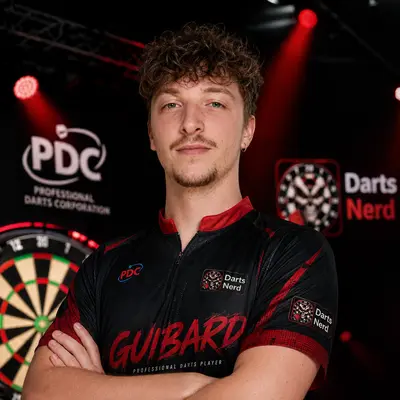
The Grand Slam of Darts gets underway this Saturday, 14 November 2026, at the WV Active Aldersley in Wolverhampton, for nine days of competition and a 20th edition that bears little resemblance to the 2007 tournament. Forty-eight players, sixteen groups, a million pounds up for grabs: the tournament, originally devised to pit the best players from the PDC and the BDO against one another, has become a mass event, with a format that punishes even the slightest misstep.
A tournament born out of the rivalry between the BDO and the PDC
The story begins in 2007, at the Wolverhampton Civic Hall. At the time, the Grand Slam of Darts was conceived by Barry Hearn as a response to the rift in professional darts: to bring together players from the PDC and the BDO – then rival organisations – in a single competition, with the promise of crowning ‘the greatest of them all’. The British public was introduced to a group-stage format, a single stage and unprecedented match-ups.
PDC players dominated the tournament for many years, with one now legendary exception: in 2010, BDO player Scott Waites came from 8-0 down to defeat James Wade in the final, winning 16-12. He remains the only BDO winner to date. Following the dissolution of the BDO in 2020, the 2021 edition is being held for the first time without any BDO representatives, who have been replaced by qualifiers from the PDC’s secondary circuits.
Sixteen groups of three, one survivor
The most noticeable change in the 2026 tournament concerns the field, which has been expanded from 32 to 48 players. The players are divided into sixteen groups of three, each featuring a top seed, and each group plays a round-robin format: two matches per player, with two points awarded for a win.
The consequence is brutal. Only one player per group progresses to the round of 16, leaving sixteen qualifiers for the knockout stage. A defeat in the first match does not mathematically rule a player out, but it does mean they must keep a close eye on the set differential, as all matches are played in legs. Over nine days, the schedule is packed, with sessions following on from one another from the very first weekend.
Prize money has risen from 650,000 to 1,000,000 pounds
The expansion of the field is accompanied by a historic increase in prize money, which has risen from 650,000 pounds in 2025 to 1,000,000 pounds this year. The winner takes home 200,000 pounds and the Eric Bristow Trophy, named after the five-time world champion who passed away in 2018.
The prize money is distributed across the entire field: £100,000 for the runner-up, £60,000 for each semi-finalist, £35,000 for the quarter-finalists and £20,000 for those reaching the last 16. Players eliminated in the group stage do not leave empty-handed, with 12,500 pounds for second place in a group and 5,000 pounds for third place. On a circuit where every pound counts towards the rankings, these prize sums also carry weight in the race for World Championship qualification.
Littler the favourite, Greaves to open proceedings
Luke Littler arrives in Wolverhampton as a two-time defending champion, having won the title in 2024 and 2025. Last year, he beat Luke Humphries 16-11 in the final and went on to take the world number one spot. The draw has set up a highly anticipated opening fixture for him: he faces Beau Greaves in the very first session, in a three-player group where only one qualifying place is up for grabs.
The WDF world champion had said she was looking forward to this clash at the time of the draw, aware that the format leaves no room for manoeuvre. The match serves as a test for both players: for Littler, it’s about launching her title defence without wasting energy in a tricky group; for Greaves, it’s about holding her own against the world’s best player on a stage she is now familiar with.
A line-up without Anderson, featuring ten qualifiers
Not all the top players will be there. Gary Anderson has withdrawn from the Tour Card Holder Qualifier and will miss the Wolverhampton tournament, having no other route to qualification. Michael Smith, Damon Heta and Danny Noppert also failed to qualify at the qualifier held in Leicester.
Ten players, however, secured their places there, including Stephen Bunting, Joe Cullen and Niko Springer. Their presence further expands a field that mixes finalists from major televised tournaments, Pro Tour winners and last-minute qualifiers, promising mismatched fixtures on paper and surprises in the group stage.
One question remains, made all the more crucial by the format: with three players per group and only one qualifying, the 2026 Grand Slam will leave no room for a ‘feeling-out’ round. From this Saturday onwards, every match will count double.