The debate has been rumbling in darts circles for several weeks now. The current Premier League PDC format is coming under increasing criticism from players and fans alike. Week after week, the same matches are being played over and over again, and the public is starting to tune out. So the question arises: what would the rankings look like if the competition were still played under the old system? The simulation carried out by our Dartsnews colleagues reveals a much more competitive play-off race, and reopens the debate on the relevance of reforming the format. This article takes a look at how the old format worked, presents the two simulated tables, analyses the surprises they reveal, particularly for Luke Littler, Luke Humphries and Josh Rock, and sets out the limits of the exercise.
The old Premier League format: what fans have lost
For years, the Premier League of darts operated on a simple and frighteningly effective model. Each night of the competition, each player played a single match. A win earned two points, a draw one point, a defeat nothing. The overall picture progressed gradually, night after night, with constant pressure on each individual performance.
The Judgement Night, a merciless moment of truth
The most dramatic element of the old format had an evocative name: Judgement Night. After nine nights of competition, the two players at the bottom of the leaderboard were eliminated. The season then continued with eight players until the final play-offs. This was a time of concentrated tension that the current format does not reproduce. Being ninth or tenth after nine nights meant going home. No appeal.
At the time, the Premier League had ten participants. The fixtures on the final nights were decided by ranking, which added an extra strategic dimension: your position in the table directly influenced the opponents you would face.
What the current format has changed
The current system multiplies matches per evening. Each player potentially plays a semi-final and a final on the same night. A win on the night can earn up to five points. As a direct consequence, gaps open up more quickly, positive or negative series have an amplified impact on the standings, and a struggling player can find himself mathematically out of the running well before the end of the regular phase.
This is precisely what critics of the current format are pointing the finger at.
The simulation: methodology and two separate tables
For this simulation, only the first-round matches of each evening are taken into account. This is the most consistent rule of comparison: in the old format, each player only played one match per night. The first-round clashes from the season therefore form the database.
An important clarification: night number 9 would probably have been composed differently in the old system, since fixtures there were determined by ranking. Despite this limitation, the matches on this night are integrated to offer the most complete table possible. Forfeits are treated according to the rules in force in the current system: the absent player concedes a 0-6 loss in legacies, his opponent receives two points and a 1-0 win in legacies.
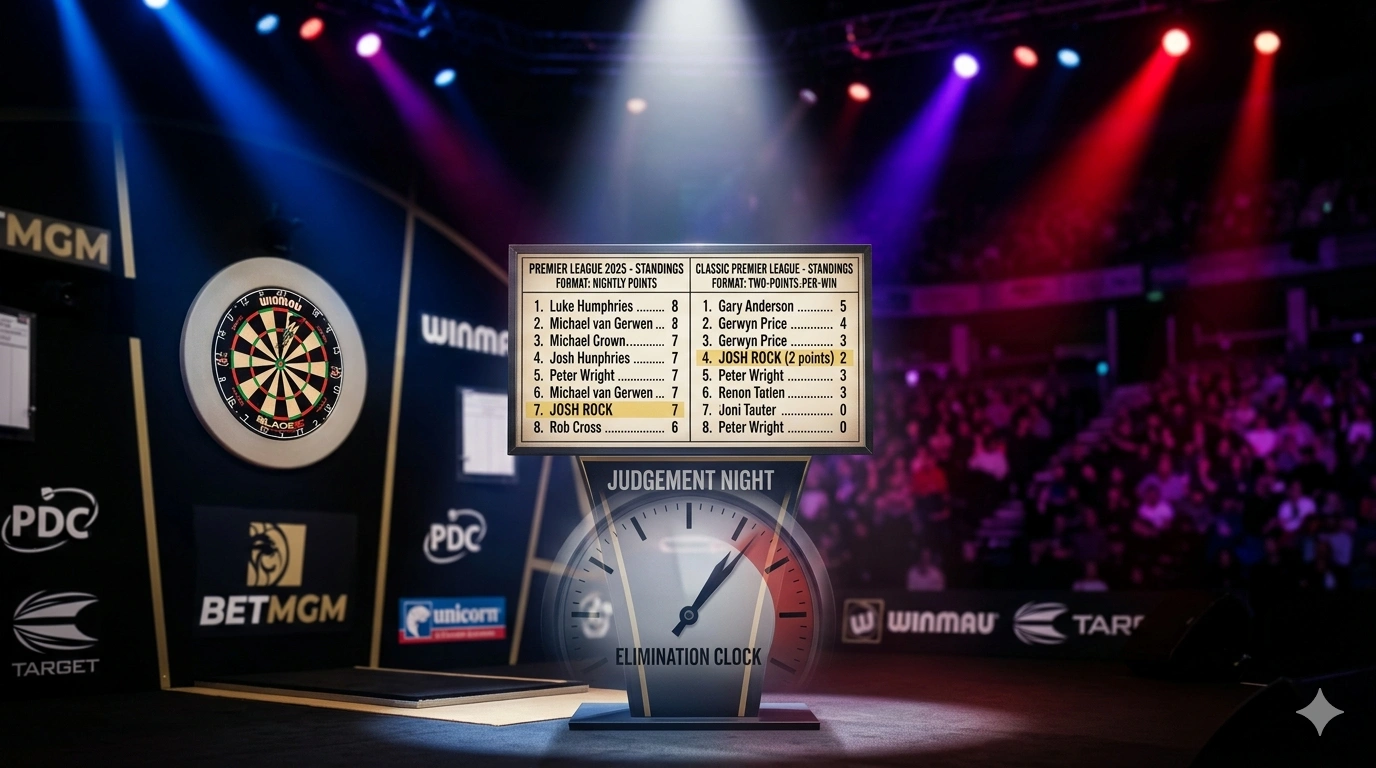
Two tables were constructed: one without counting draws, the other including them. The results differ significantly.
Table without draws: Littler in the lead, but the hunt is on
| Position | Player | Points | Situation |
|---|---|---|---|
| 1 | Luke Littler | Leader | Qualified, advance by legacy difference |
| 2 | Jonny Clayton | Close | Racing for 2nd place |
| 3 | Luke Humphries | Close | Good legacy difference to come back |
| 4 | Gerwyn Price | In the running | Direct duel with Van Veen to be expected |
| 5 | Gian van Veen | In contention | Tied with Price for 4th place |
| 6 | Josh Rock | 4 pts behind Top 4 | Still mathematically in the race |
| 7-8 | Other | Eliminated or out of the running | - |
Luke Littler would remain leader thanks to a better legacy difference. Behind him, the fight would be much tighter than in the reality of the season. Jonny Clayton and Luke Humphries would battle for second place, with Humphries having a favourable enough legacy difference to hope to come back. The duel for fourth place would pit Gerwyn Price directly against Gian van Veen. The two players would even have met in a head-to-head match, making this a vital fixture.
The main lesson of this table is arithmetic. When the maximum per evening is two points instead of five, the gaps mechanically remain smaller. A leader cannot widen a gap so quickly. Each evening remains a real stake for everyone.
The Josh Rock case: a perfect illustration
The case of Josh Rock deserves particular attention. Under the current format, the Northern Irishman has suffered from a number of early eliminations that have quickly plummeted his points total. The snowball effect is relentless under the current system: going out in the semi-finals night after night ends up widening a gap that is hard to close.
In the simulation without draws, four consecutive wins for Rock would have put them just four points outside the top four. Four points. That proximity to the play-offs would probably have changed his mindset and approach to the following nights. Confidence in darts is not anecdotal: it can be read in averages, in successful checkouts, in decisions taken under pressure.
Table with draws: the rankings tighten again
| Position | Player | Points | Final scenario |
|---|---|---|---|
| 1 | Luke Littler | Leader | Humphries can still join him |
| 2 | Luke Humphries | Qualified | Can finish 1st to 3rd |
| 3 | Jonny Clayton | Qualified | In play-offs, position to be confirmed |
| 4 | Gian van Veen | 15 pts | Best position for 4th place |
| 5 | Gerwyn Price | 14 pts | One point behind van Veen |
| 6 | Michael van Gerwen | 14 pts | Still racing despite a difficult season |
| 7 | Stephen Bunting | Close to the bottom | Theoretically still alive |
| 8 | Josh Rock | Bottom of the table | In danger, but less ruled out than at present |
With the draws built in, the situation becomes more complex at every level of the table. Luke Humphries could yet join Littler at the top. Jonny Clayton would be assured of a play-off place, but his final position would remain uncertain. Fourth place would be completely open between Gian van Veen, Gerwyn Price and Michael van Gerwen, separated by just one point.
Surprises from the simulated rankings: what the data reveals
Michael van Gerwen still in the race
The most striking piece of data from the simulation with draws concerns Michael van Gerwen. The Dutchman's season has been disappointing by his usual standards. Under the current format, he has accumulated insufficient results that have gradually pushed him out of the play-off race.
Under the old format, with 14 points, van Gerwen would still be fully in the battle for fourth place. This is one of the clearest virtues of the old system: it keeps players in contention for longer, including those going through a difficult period. A Michael van Gerwen with a real hope of qualifying is still a dangerous Michael van Gerwen for everyone.
Evening 14 and the importance of draws
Night number 14 of the season is a textbook case. Almost every game on this night ended 5-5. Only one player managed to come out on top: Jonny Clayton, who beat Gerwyn Price. Under the old format with draws, this night would have had a huge impact on the standings. Clayton would have taken two points when his rivals took just one. This type of evening would have created decisive gaps where the current format dilutes them in the mass of results on the same night.
Gerwyn Price flunked despite apparent safety
In the current format, Gerwyn Price looked relatively safe for the play-offs for several weeks. The simulation with draws tells a different story: Price would find himself in fifth place, behind van Veen. A single point would separate the two players. The perception of comfort that the current format can create disappears in the old system. Everything remains open until the end.
The limits of the comparison and what it says about the reform debate
Playing to win or playing not to lose
Simulation has a fundamental limit that must be clearly named. A leg played at 5-4 in the current format, when a win is worth five points, is not like a decisive leg played to pick up two points or preserve a one-point draw in the old system. The psychology of the player changes depending on exactly what is at stake in the situation.
In the old format, a player leading 4-3 could potentially manage his checkout strategy differently depending on whether he was aiming for victory or securing a draw. Reforming these calculations in real time is an integral part of the game. The matches produced under the old format were not the same as those played today, even with the same score.
Series wins would have had even more impact
Paradoxically, the old format would have both reduced the overall spreads and amplified the impact of the series. Four straight Josh Rock wins are worth so much more when only the single match of the night counts. Under the current format, a semi-final loss before a final win pollutes the evening's balance. Under the old system, a win is a win, and a four-game series stays whole in the stats.
Will the PDC finally make a move?
The question of the Premier League format is not a new one, but it is gaining in intensity. Fans who also follow the Pro Tour or European Tour are used to sharper formats, where every match is a potential final. The current Premier League format can give the feeling that the most decisive evenings are drowned out by a stream of predictable confrontations.
No official announcement from the PDC on a reform of the format has been communicated at this stage. What this simulation does show, however, is that the old system would have produced a tighter ranking, kept more players alive for longer, and made each evening potentially more decisive in the play-off race.
That's exactly why this debate deserves to be taken seriously.
The old format mechanically reduced the gaps thanks to a maximum of two points per night.
Judgement Night created a moment of dramatic tension that the current format does not replicate.
Players like Josh Rock or Michael van Gerwen would have kept their luck much longer.
Evenings almost entirely made up of draws, such as evening 14, would have had a decisive weight on the standings.
The comparison remains partial: the strategic context of each match changes according to the points system in force.
The next step for the Premier League is the current version of Judgement Night - and the play-offs that will follow. If the PDC ever decides to return to a format close to the old system, this simulation suggests that the public would gain in suspense. Whether the PDC is ready for that choice remains to be seen.