Barry Hearn is not announcing a Premier League Darts revolution, but he has confirmed that the format remains on the table. In comments carried by DartsNews on Thursday, the Matchroom boss explained that the PDC still has to balance commercial stability, fan expectations and the need to keep a real sporting edge every week.
The key point is timing: Hearn says the internal decision should be settled in September. After a 2026 season still marked by criticism of repeated fixtures and the eight-player weekly knockout system, this is no longer just a fan debate. It is now inside the window where the PDC starts shaping the 2027 version of its Thursday night roadshow.
A format that still sells extremely well
Hearn first explained why the PDC is unlikely to tear everything up without a serious reason. According to the figures he cited, the Premier League sold 99.21% of available tickets last year. In his view, that casual audience carries more weight than the loudest criticism from the sport’s core fanbase.
The reading is fairly straightforward: if arenas are full, TV ratings are holding and every player wants a place in the competition, the PDC has little incentive to take a drastic risk. Hearn made clear that opinions matter, but they have to be weighed against a product that is still working very well commercially.
| Key point | A decision is expected in September for the 2027 format. |
|---|---|
| Commercial signal | Hearn cites 99.21% ticket sales from the latest campaign. |
| Option discussed | A return to some form of elimination or relegation remains possible, but risky. |
| Current reading | A targeted tweak looks more likely than a full rebuild. |
Relegation is back in the conversation
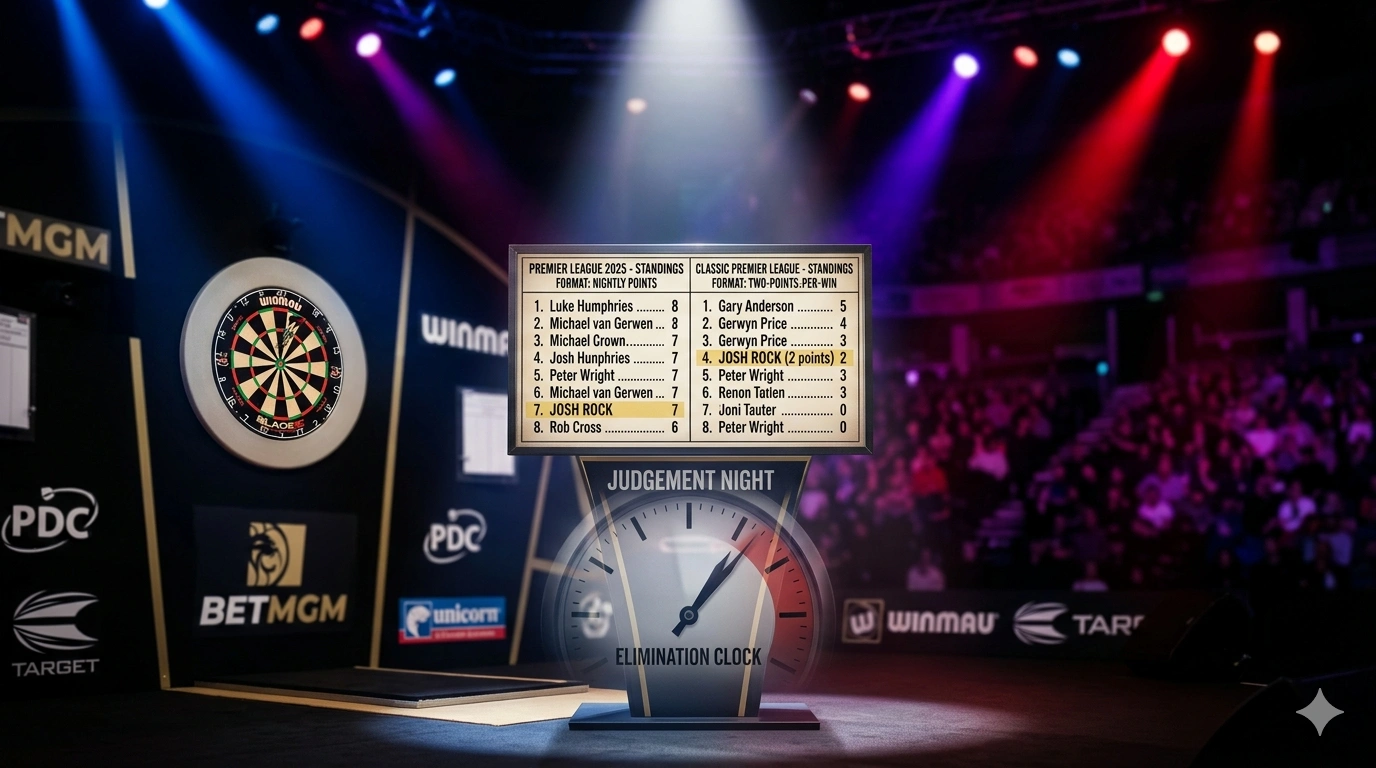
The most interesting part of Hearn’s comments concerns the idea of mid-season elimination. He accepts that bringing back a form of relegation could make the competition sharper. The old Judgement Night system had that obvious benefit: after several weeks, players near the bottom were genuinely fighting to stay alive.
But the problem appears immediately. If a huge name has two or three bad weeks and exits too early, fans who bought tickets for one specific city may miss the player they paid to see. That is the central tension of the modern Premier League: creating jeopardy without damaging the commercial promise made to arenas.
The debate links directly to Hearn’s recent warning over absent European Tour stars. The logic is similar: the PDC wants to protect its major products, but it knows that names on the poster are still a crucial part of the value sold to fans.
Why repeated fixtures frustrate some fans
Since 2022, the Premier League has used eight players and a mini-tournament every week. The system guarantees plenty of matches between the best players, but it also creates obvious fatigue: the same duels return again and again, while the league table can quickly lose tension for players who fall behind early.
Hearn does not dismiss that argument. He admits some British fans feel they are seeing the same match-ups week after week. But he also defends the other side of the case: for a spectator who only attends one night a year in Manchester, Aberdeen, Cardiff or Rotterdam, seeing the best players on stage remains the first priority.
That is where the PDC is walking a fine line. Too much stability can make the event feel like a closed tour. Too much risk can remove a star before some cities have seen him. For a product sold as a big entertainment night, the calculation is never purely sporting.
What the PDC can realistically change
At this stage, the most credible scenario is not a full return to the old format. Hearn instead suggests the PDC may keep the current base for another season, perhaps with a small adjustment. That could mean a slightly revised points mechanic, a way to sharpen the closing weeks, or a rule that gives more weight to the bottom of the table without eliminating star names too early.
Let’s be clear: if the Premier League keeps filling arenas, the PDC does not need a spectacular reform to save the product. It does, however, need to avoid the competition being seen as too comfortable for established players. That is the real issue here: keeping the stars, while putting a little more danger back into the format.
September is now the month to watch
Hearn’s key line is that the issue should be resolved internally in September. That leaves limited time before preparation begins for the 2027 Premier League, which usually starts early in the year. In other words, the next version of the format is being decided now.
The editorial caution is obvious: there is no confirmed reform yet, so this should not be framed as a done deal. But it is a story worth tracking closely. Between ticket sales, TV value, fan pressure and the relegation debate, the Premier League has reached a point where a small change could matter more than it first appears.
Main source: DartsNews on Barry Hearn’s comments, based on an interview with Online Darts.