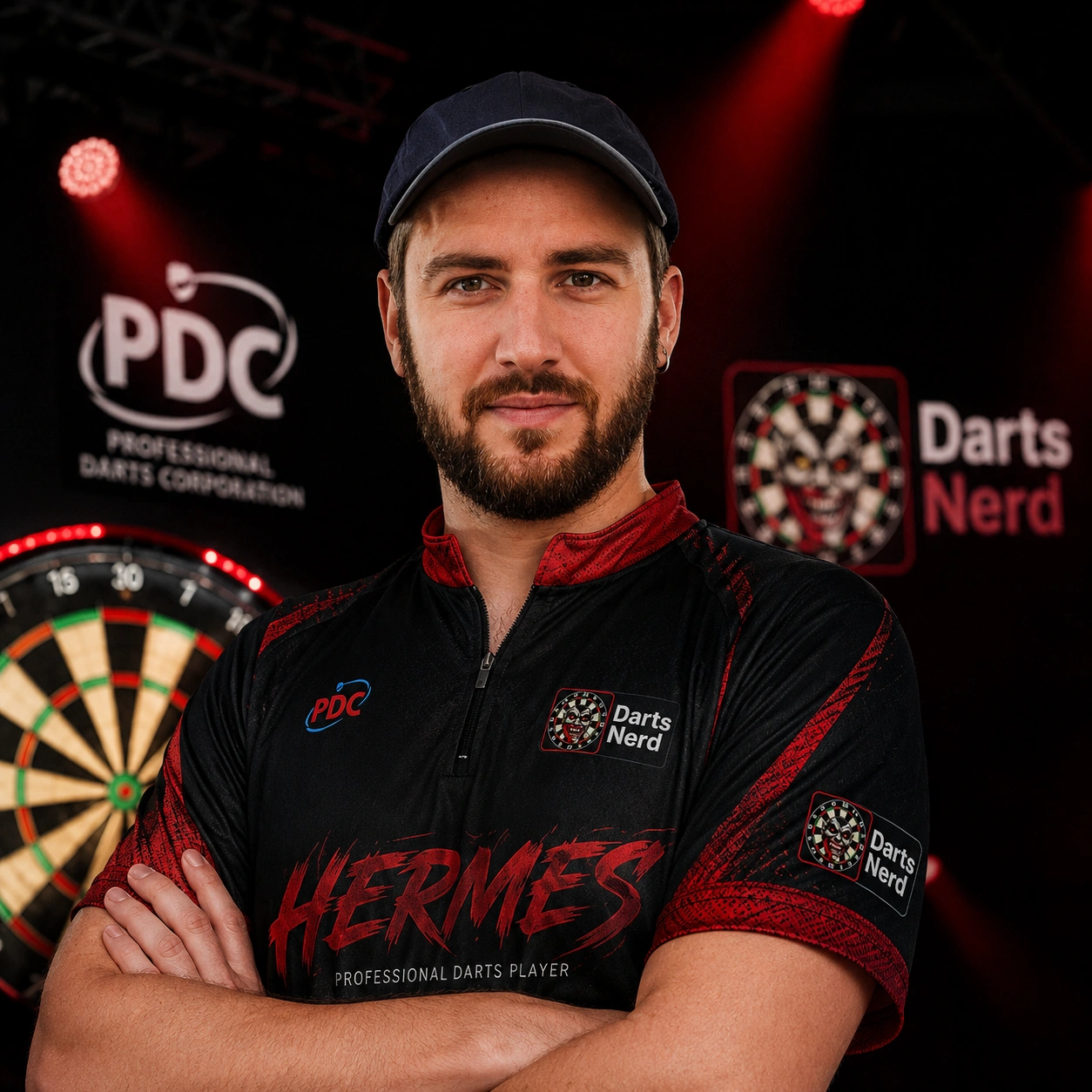
Luke Humphries has chosen to speak candidly about a subject that is rarely addressed so directly in the world of darts: his mental health. In a statement published by the PDC in partnership with the Samaritans to mark World Suicide Prevention Day, the former world number one explains how an anxiety attack in 2019 almost led him to end his career.
This isn’t a story about scores, but it matters. Humphries recounts, in particular, the moment he decided to seek help, and the path that followed: a world title, a World Cup, a World Matchplay and nine major titles. A few weeks after his victory at the Players Championship 28, this statement offers a different perspective on his return to the forefront.
A rare admission in a highly publicised sport
On Thursday, the PDC published Humphries’ account, centred on his conversation with a volunteer from the Samaritans. In it, the player looks back on a very difficult period in his career, in the midst of a long run of PDC tournaments. In 2019, he suffered an anxiety attack during a competition and found himself, in his own words, considering calling it all off.
The most striking line is simple: “I felt my career was coming to an end.” Humphries says he was overwhelmed by stress, to the point where he thought carrying on was becoming impossible. This is no longer the polite rhetoric of a champion talking about pressure after a defeat. He describes a genuine breaking point.
He chose to speak out. First to a doctor, then to his loved ones. “The best thing I did was go and see a doctor and tell him how I was feeling,” he explains in the account shared by the PDC and reported by Sky Sports. This passage lends weight to the message, because it doesn’t gloss over the difficulty. Above all, it shows that the rest of his career wasn’t built in spite of this request for help, but partly because of it.
What Humphries brings to the table
The account comes at a specific time: World Suicide Prevention Day and Humphries’ partnership with the Samaritans, a 24-hour helpline in the UK and Ireland. The organisation points out that one in four people may experience suicidal thoughts at some point in their lives, and that suicide remains the leading cause of death among men under 50 in the UK.
| Player | Luke Humphries |
| Background | Partnership with the Samaritans for suicide prevention |
| Event mentioned | Anxiety attack during a PDC competition in 2019 |
| Key message | Asking for help was a turning point in his career |
Humphries does not claim that everything has gone away. He says he still experiences moments of anxiety, sometimes in unexpected situations, far from the spotlight and the visible pressure. The difference, he says, lies in how he manages them: not letting the spiral take hold, recognising what is happening, and knowing that there are solutions.
That is also why this account goes beyond Humphries’s individual case. Darts is often portrayed through the noise of the venue, the walk-ons, the averages and the checkouts. But the PDC circuit also involves travelling, back-to-back tournaments, the loneliness of certain journeys and constant exposure. When a player of this calibre puts this aspect into words, the sport matures.
A different kind of leadership
Sky Sports also quotes Simon Gunning, chief executive of CALM, who praises the potential impact of speaking out. His point is clear: when a champion like Humphries shares his experience, he can empower others to speak out in turn. It’s less spectacular than winning a title, but it’s no less important.
For Humphries, the timing is interesting. On the oche, he remains one of the circuit’s leading figures. Off the oche, he reminds us that a champion’s career is not just about the list of honours. His journey since 2019 tells a different story: a player can go through a very dark period, seek help, and then come back stronger without having to hide that part of their story.
At this level, the message is almost more powerful because it comes from a player who has won everything – or almost everything. Humphries isn’t speaking from the sidelines. He’s speaking from the top, with enough perspective to say that opening up to others has changed his sporting and personal life. In a sport where the pressure is felt most keenly when aiming for the doubles title, those words carry weight too.
Where to find help
If you are in France and are experiencing suicidal thoughts, or if you are worried about a loved one, 3114 is the national suicide prevention helpline, which is free and available 24 hours a day. In the UK and Ireland, the Samaritans can be reached free of charge on 116 123. In the event of immediate danger, you should contact the emergency services in your country.