Scram is a two-player darts game in which each player takes turns playing two opposing roles: one chases points while the other tries to close everything out before them. Easy to understand, fast-paced to play: it’s a variation of the famous Cricket, but more accessible to beginners.
In this guide, you’ll learn the complete rules of Scram and how to start your first game, even with no experience.
Scram | Details |
|---|---|
👤 Players | 2 (exactly) |
🎯 Difficulty | Easy |
⏱️ Duration | 10 to 15 minutes |
🎲 Equipment | One dartboard + 1 set of 3 darts per player |
🏆 Objective | Score the most points on the numbers still open |
Scram at a glance: the objective of the game
In Scram, the two players have opposing roles that switch during the game:
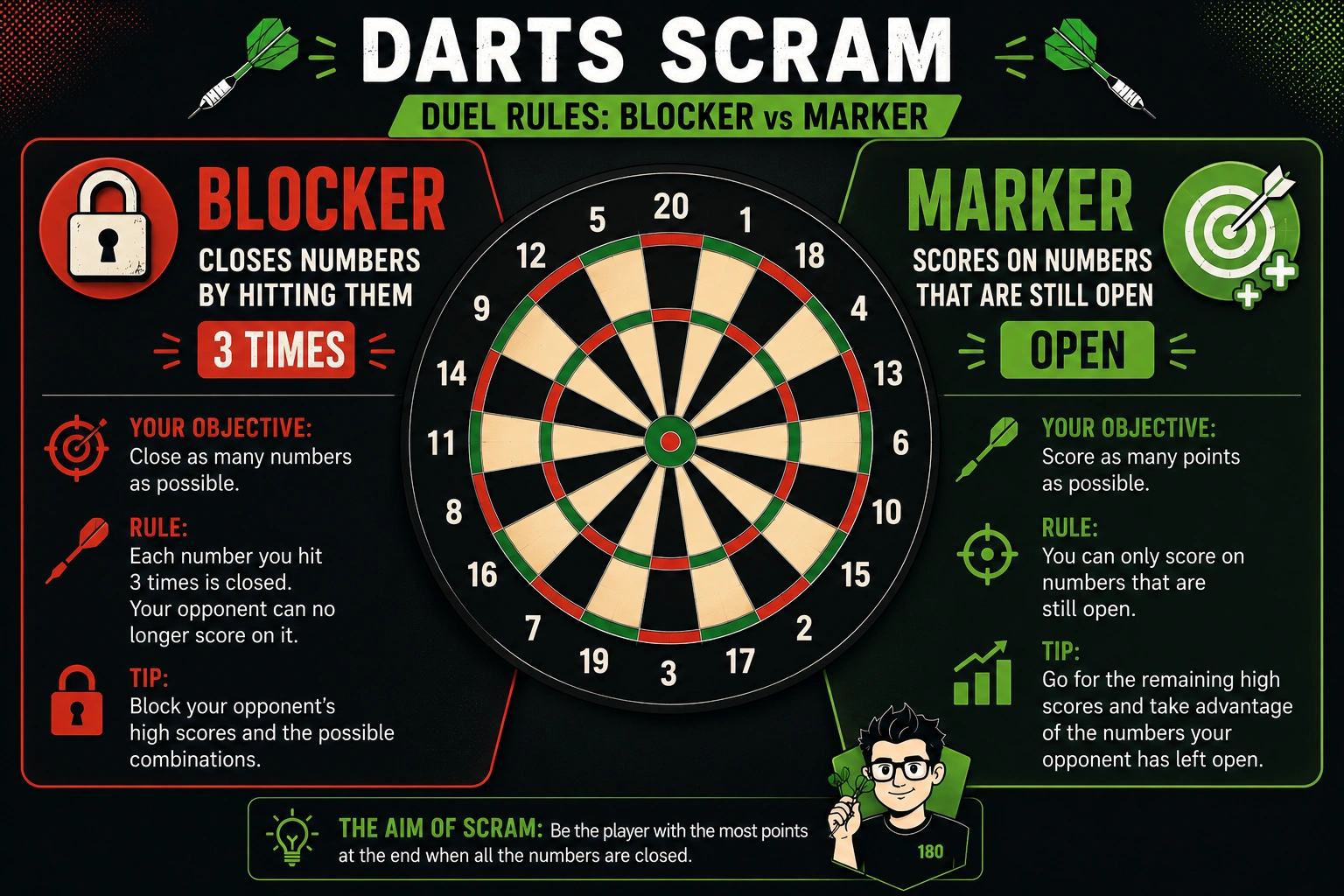
The Blocker must “close” the numbers on the dartboard as quickly as possible.
The Scorer must score as many points as possible on the numbers that are still open.
The game consists of two rounds: in the second round, the players switch roles. At the end, the player who has accumulated the most points as the Scorer wins.
What you need to play
The equipment is minimal:
A standard dartboard set up at the correct distance and height
3 darts per player
A scoreboard to record the numbers hit and the points
Understanding the two roles
The Blocker
Their objective: to close numbers. To close a number, you must hit it three times (in one or more attempts). The numbers in question are 15, 16, 17, 18, 19, 20, and the bullseye (as in Cricket). Once a number is closed, it no longer earns the Scorer any points.
The Scorer
Their objective: to score as many points as possible on all the numbers that haven’t yet been closed by the Blocker. The faster they score, the better, because the Blocker closes the numbers one by one.
🎨 [MEDIA TO BE INSERTED] — “Who Does What” infographic. Type: comparative infographic. Location: end of the section on roles. Prompt: “Two-column infographic side-by-side: on the left, BLOCKER (padlock icon, “closes numbers by touching them 3 times”); on the right, SCORER (target + points icon, “scores on numbers still open”). A target in the center. Darts-nerd style.”
How a round works
The Blocker throws his 3 darts first: he tries to close numbers. Then, the Scorer throws his 3 darts: he scores points on everything that’s still open. And so on, taking turns.
The round ends as soon as the blocker has closed all the numbers (15 to 20 + center).
Example: Paul is the blocker, Marie is the scorer. Paul hits the 20 three times → the 20 is closed. Marie can therefore no longer score on the 20. But the 19 is still open: she aims for the triple 19 and scores 57 points (3 × 19). The round continues until Paul has closed everything.
The second round: roles are reversed
Once the first round is over, the players switch: Marie becomes the blocker, Paul becomes the scorer. The principle is exactly the same.
At the end of both rounds, the points scored by each player during their turn as scorer are compared. The highest score wins.
To wrap up our example: Marie scored 180 points, Paul 145. Marie wins the game.
Start your first game of Scram (summary)
1. Set up the target
2. Decide who starts as the blocker and who starts as the scorer
3. The blocker closes numbers 15 through 20 plus the center (3 pins each)
4. The scorer scores on all numbers still open
5. The round ends when everything is closed
6. Switch roles for the second round
7. The highest score at the end wins
Scram or Cricket: What’s the Difference?
Scram is inspired by Cricket (darts cricket rules), but with one major difference: in Scram, the roles are asymmetrical (one blocks, the other scores), whereas in Cricket both players do the same thing at the same time. Scram is therefore often easier for a beginner to grasp, since you focus on a single task at a time.