Summary:
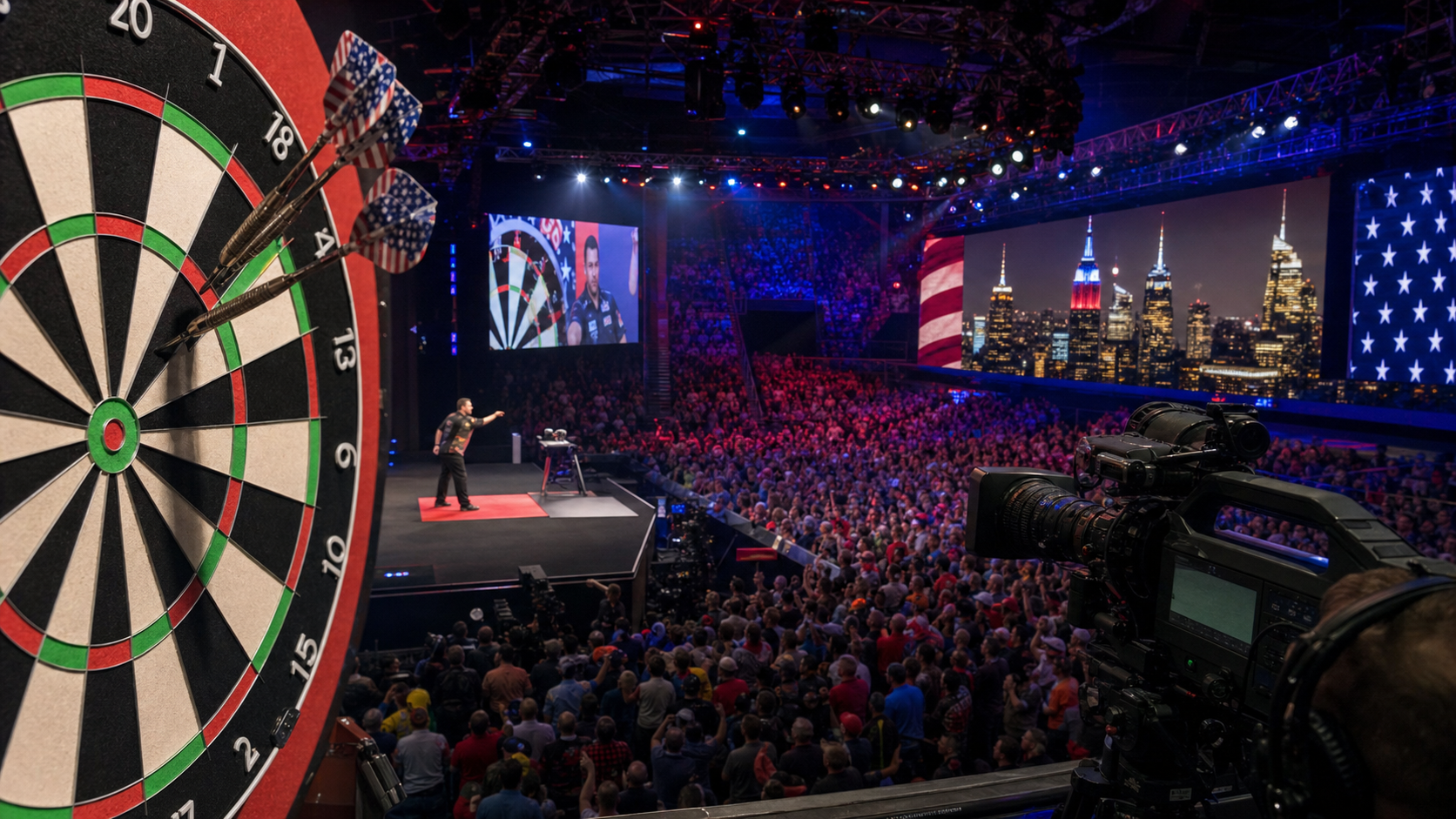
The PDC has announced a new deal with ESPN to broadcast five major darts events in the United States via ESPN2 and ESPN+. Coverage begins this week with the 2026 US Darts Masters in New York, and will then extend to the World Matchplay, the World Grand Prix, the Grand Slam of Darts and the World Darts Championship.
The five events covered by the ESPN deal
The announcement is not simply a one-off trial. It establishes PDC darts as a genuine portfolio of premium competitions, spread across several key moments in the calendar. In other words, American audiences will not just see a single World Series weekend: they will have access to several key events that shape the circuit’s sporting year.
| Event | Venue | Announced date |
|---|---|---|
| US Darts Masters | Madison Square Garden, New York | 25–26 June 2026 |
| World Matchplay | Winter Gardens, Blackpool | 18–26 July 2026 |
| World Grand Prix | Mattioli Arena, Leicester | 28 September – 4 October 2026 |
| Grand Slam of Darts | WV Active Aldersley, Wolverhampton | 14–22 November 2026 |
| World Darts Championship | Alexandra Palace, London | TBC |
The business implications are significant: ESPN is not simply acquiring a minor competition, but a selection of events covering an American leg, a well-established summer tournament, two major autumn events and the World Championship. This represents a much stronger presence than a mere opportunistic purchase of rights.
Why this deal really matters for the PDC
For several seasons now, the PDC has been highlighting the growing interest in darts across North America. The US Darts Masters, the North American Championship and the growing visibility of certain local players are already part of this strategy. With ESPN, the scale of the operation changes: the sport gains a very powerful mainstream broadcaster, capable of reaching a wider audience than just the core group of fans who already subscribe to specialist services.
This point is crucial, because the growth of a sport depends not only on the quality of the field or the density of its calendar. It also depends on consistent exposure. By providing a coherent sequence of events stretching from New York to Alexandra Palace, the agreement creates a sense of narrative continuity for the American audience. It is not simply an isolated, exotic event that is being shown: it is a circuit, featuring recurring stars and several recognisable highlights.
The message sent by Matt Porter
In the official statement, PDC Chief Executive Matt Porter emphasises two points. Firstly, the desire to make the biggest tournaments more accessible to American fans. Secondly, the idea that the United States has become an increasingly important market for the federation. The message is crystal clear: this agreement is not presented as a bonus in terms of visibility, but as a deliberate step in the circuit’s international strategy.
This positioning is consistent with the chosen timing. Coverage begins just as the US Darts Masters returns to New York, turning an already symbolic weekend into a gateway to other major events. For ESPN, it is a way of immediately gauging interest in an event held on American soil. For the PDC, it is a way of channelling local momentum directly into its most profitable and best-known competitions.
What this means for the US market
In the short term, the most obvious effect will be simple: following the PDC from the United States will become easier. But the real stakes go beyond the convenience of broadcast access. A regular presence on ESPN2 and ESPN+ could help the PDC cement its image as a premium sporting product, better establish its star players and lend greater weight to events held on North American soil.
For Darts Nerd, this is precisely what makes this announcement a story in its own right. It is not limited to a TV schedule slot. It illustrates how the PDC is attempting to turn American curiosity into a habit of following the sport. If this broadcast finds its audience, the ESPN deal could very quickly come to be seen as a sign of darts’ expansion into a market where audiovisual competition is, nevertheless, fierce.