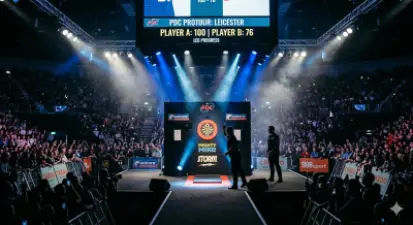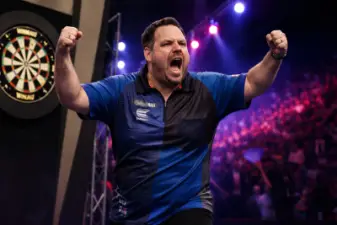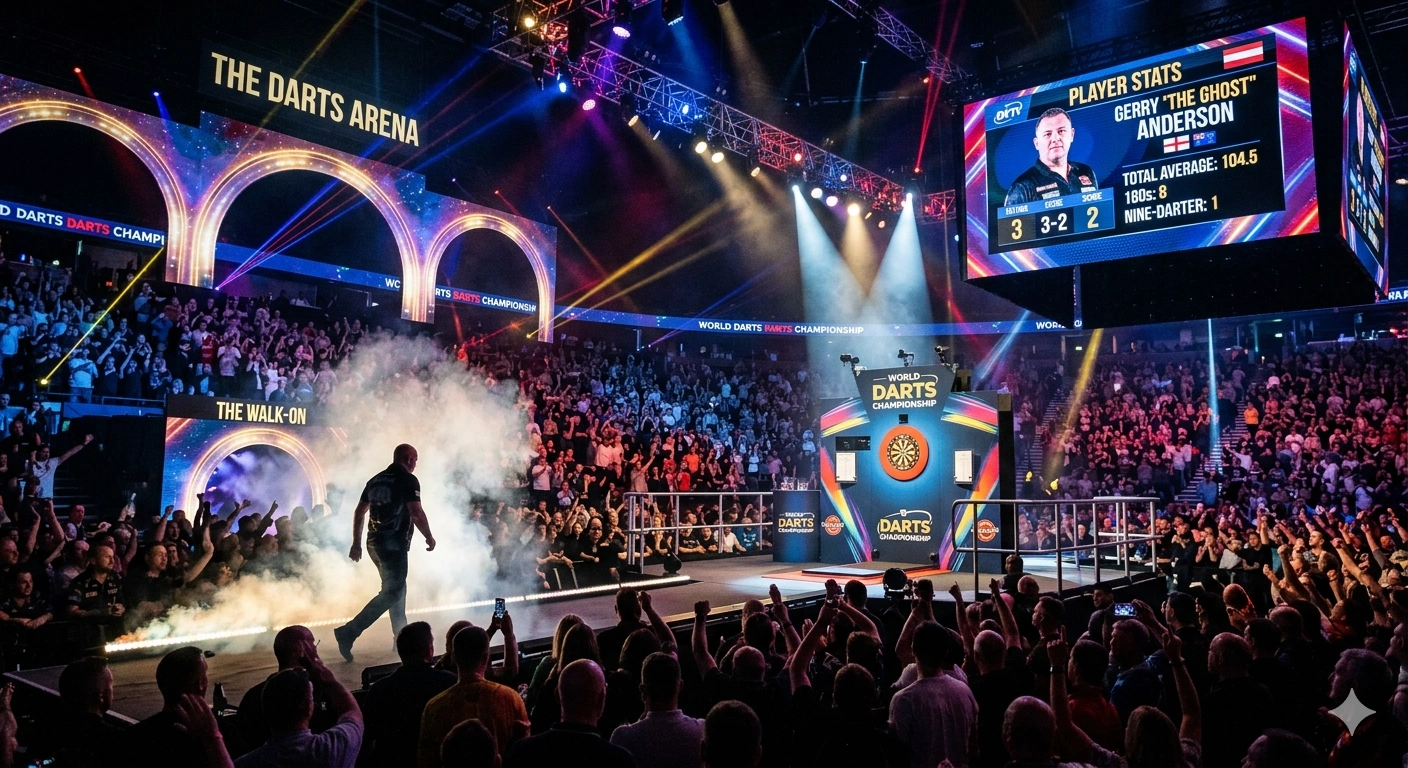
Just days before the darts Premier League final at The O2 in London, Gerwyn Price has ignited a debate that has been brewing for several seasons. On social media, the Welshman proposed a novel format inspired by the WWE's Royal Rumble: up to 26 players, a last man standing system, a symbolic belt and a place in the Premier League the following season as the ultimate reward.
This article looks at Price's proposal in detail, analyses the flaws in the current weekly tournament, explores the nostalgic return to the 10-player format, and pragmatically assesses what could really breathe new life into the PDC circuit's flagship competition.
Gerwyn Price's proposal: the Royal Rumble applied to darts
Gerwyn Price is not being half-hearted. His proposal revolves around a standalone event, grafted onto the existing Premier League structure, which would operate along the lines of the WWE's Royal Rumble. The players would enter the stage one after the other, with the audience not knowing in advance who was going to appear. The last man standing would win a belt, a significant financial package and, above all, direct qualification for the following season of the Premier League.
This format would allow up to 26 players to be included on any one night. Names like Alan Soutar in Scotland or Wessel Nijman in the Netherlands could be cheered on by their home crowd, offering arenas an extra adrenaline rush that the current format no longer generates.
Price is not proposing to upend everything either. It wants to maintain the main competition in a sanitised format, with a return to the 10-player system. This two-pronged reform reveals a fine-tuned reading of the problem: it's not just a question of adding more spectacle, but of restoring meaning to each confrontation.
The precedent of the "Challengers" format and local heroes
The PDC is no stranger to experimentation. Between 2019 and 2021, the circuit had already incorporated outside challengers who played matches without being able to claim the title. Some evenings saw players from the world's top 16 such as Chris Dobey challenge the headliners, while others summoned players ranked much lower. This lack of fairness ended up undermining the concept.
The idea of a local hero remains attractive on paper, however. In Germany, promoting Martin Schindler, Niko Springer or Max Hopp in their own country represents real marketing leverage. An unannounced mystery player creates a surprise effect, but does not necessarily generate the same commercial impact as a local headliner known to the general public.
The current format: a sold-out weekly tournament
Since 2022, the Premier League has operated on a mini-tournament system each week. Each evening comprises quarter-finals, semi-finals and a final. The winner takes 5 points, the runner-up 3, the semi-finalists 2. Only the top 4 overall after 16 weeks progress to Finals Night.
The problem is arithmetical as much as sporting. With only 8 players in the draw, the confrontations are repeated at a pace that ends up anaesthetising interest. In 2026, Luke Littler and Luke Humphries have already faced each other 5 times in the same edition. Littler has crossed paths with Jonny Clayton 4 times. Michael van Gerwen and Price have also come face to face 4 times.
| Affrontation | Number of times played (2026) | Origin of additional encounters |
|---|---|---|
| Luke Littler vs Luke Humphries | 5 | Multiple QFs + semi-finals |
| Luke Littler vs Jonny Clayton | 4 | QF + repeated semi-finals and finals |
| Luke Humphries vs Gerwyn Price | 4 | QF + evening finals |
| Michael van Gerwen vs Luke Littler | 4 | QF + semi-finals |
| Michael van Gerwen vs Gerwyn Price | 4 | QF + finals |
| Luke Humphries vs Michael van Gerwen | 4 | QF + semi-finals |
These figures illustrate a fundamental problem. PDC regularly argues that fans want a winner every night in the arena. This argument holds as long as the posters retain their appeal. But when Littler faces Humphries for the fifth time in a few weeks, the thrill of the big clash disappears. The regular spectator finds himself in the situation of a festival-goer who would see the same headliner every night of the week.
The weariness goes beyond just the audience
Professional observers close to the circuit testify to a concrete disaffection. Some editors who specialise in PDC coverage admit that they no longer watch Thursday evenings outside of their professional activities, preferring to follow other sports. This should be a wake-up call for PDC: when the most committed fans drop out, the format has a structural problem, not an anecdotal one.
Tournaments are still filling up, it's true. But the argument of ticket sales as proof of fan satisfaction is a fragile one. People buy tickets months in advance, before they know what the evening will be like. The real penalty will come later, gradually, if the product is not renewed.
The 10-player format: nostalgia that has already shown its limits
Gerwyn Price includes in his proposal a return to the 10-player format, the one that characterised the Premier League between 2013 and 2019. That so-called Judgement Night era saw the two lowest-ranked players eliminated after the ninth night. Each player played one match per night, making match-ups less frequent and each encounter more valuable.
| Era | Years | Number of players | Main format | Key features |
|---|---|---|---|---|
| Traditional league | 2005-2012 | 7-8 | Round-robin classic | One match per player each night, draws allowed |
| Ere Judgement Night | 2013-2019 | 10 | League with mid-season relegation | Two players out after Night 9, draws allowed |
| Challengers era | 2019-2021 | 9 fixed players + guests | League with guest appearances | Challengers played without being able to win the title |
| Weekly tournament | 2022-present | 8 | Mini-tournament every night | QF, semi-finals, final every night |
The problem is that this 10-a-side format has already been abandoned precisely because it ended up seeming monotonous in its own right. The same names, the same duels, but without the tension of the immediate knockout. The PDC decided in favour of the current system, which promised more intensity each evening. The result: an intensity that has waned through overexposure.
Would the PDC accept a step backwards?
The question is directly political. Returning to the 10-player format means implicitly admitting that the 2022 innovation has failed over time. The PDC is a commercial organisation: publicly acknowledging a format error is not in its usual DNA. Yet adjustments have already been made in the past without being presented as reversals. It's all a question of communication.
A hybrid route is worth exploring: start the season with 10 players in the classic league format, then switch to the knockout system for the second half. The two eliminated on Judgement Night would disappear, with the remaining eight entering the weekly tournament phase. Viewers would get variety in the first half of the season and intensity in the second. Jeopardy would be real midway through, reigniting interest precisely when it usually wanes.
Editorial analysis: urgent reform or PR stunt?
Is Price's proposal serious or part of a calculated buzz a few days before the final? Probably both. Price is not naive. He knows that his Royal Rumble idea won't pass the PDC as is. But by stating it publicly, he is forcing the organisation to respond and fuelling a debate that many players have in mind without expressing it.
What works about Price's idea
The surprise effect of the players' revelation creates a dramatic tension that the current format no longer produces.
Incorporating non-top 8 players like Nathan Aspinall, James Wade or Danny Noppert addresses a real frustration: World Championship level players who never see the Premier League.
The reward of qualification for the following season gives a concrete sporting stake, not just a symbolic one.
The standalone event format, separate from the main competition, preserves the sporting integrity of the Premier League while adding a layer of entertainment.
What's problematic
The "last man standing" mechanism applied to an individual precision sport raises unresolved logistical questions. If a player goes 15 consecutive nights without losing and loses on the last night, what is his status? Price's proposal doesn't provide a clear answer.
The WWE operates on scripted storylines. Darts is an actual competition. The dramaturgical framework of professional wrestling doesn't translate directly to a sport where every leg really counts.
An event too focused on spectacle risks undermining the credibility of the Premier League with hardcore fans, who already criticise the current format for lacking sporting substance.
The PDC would have to manage the logistics of 26 potential players, their availability, contracts and prize money on the same already busy evening.
Credible alternatives
There are several more realistic avenues worth taking seriously. The first: expand the main field to 10 players by systematically integrating two additional players selected on the basis of the PDC Order of Merit ranking. Aspinall, Noppert and Wade would thus have their place without having to invent a parallel mechanism.
The second: reintroduce an exhibition match to open the evening, pitting a local legend against a former professional. In Aberdeen, that might mean John Henderson versus Gary Anderson. In Rotterdam, a local Dutch hero. Wayne Mardle, a former World Championship semi-finalist, would be a natural candidate for this type of format.
The third, more structural one: changing the points system to create real suspense throughout the 16 weeks. At present, the mechanics of qualifying for Finals Night are readable too early. Adding a points differential between positions or introducing a bonus for performances over several consecutive nights would recreate some mid-season tension.
What is certain is that the unanimity of observers on one point deserves to be heard by the PDC: the current format lacks jeopardy over time. When the most loyal fans, those who cover the competition professionally, say they have dropped out, the signal is a serious one.
| Era | Duration of matches | Points system | Notable feature |
|---|---|---|---|
| 2005-2012 | Best of 14-16 legs | Win = 2 pts, Draw = 1 pt | Pure league system |
| 2013-2019 | Best of 12-14 legs | Win = 2 pts, Draw = 1 pt | Relegation to Judgement Night |
| 2019-2021 | Similar to previous years | Standard league points | Invited challenger appearances |
| 2022-present | Best of 11 legacies per night | Winner = 5 pts, Finalist = 3 pts, Semi-finalist = 2 pts | Mini-tournament each week |
Finals Night at The O2 remains a fixture that delivers in terms of spectacle. Four players, one night, one champion. But while the road to it loses interest week after week, the finish itself suffers from a lack of story. A champion is built over an entire season, not just one night of playoffs.
This 2026 final between Luke Littler, Luke Humphries, Jonny Clayton and Gerwyn Price will be played out under the floodlights of The O2. What comes next, however, is the real question for the PDC: what will the 2027 Premier League look like? The answer will determine whether the competition regains its status as a must-see fixture or continues to lose its most committed viewers.
This is why Price's proposal, however imperfect, deserves more than a shrug. It says something true about the state of a competition that needs to reinvent itself.
That's why Price's proposal, however flawed, deserves more than a shrug of the shoulders.