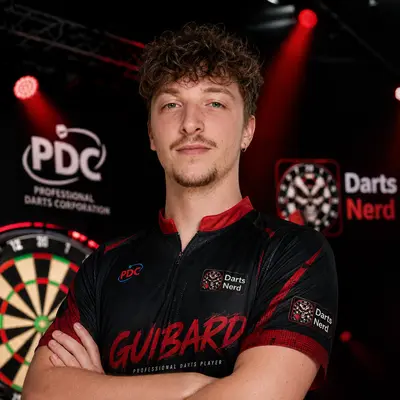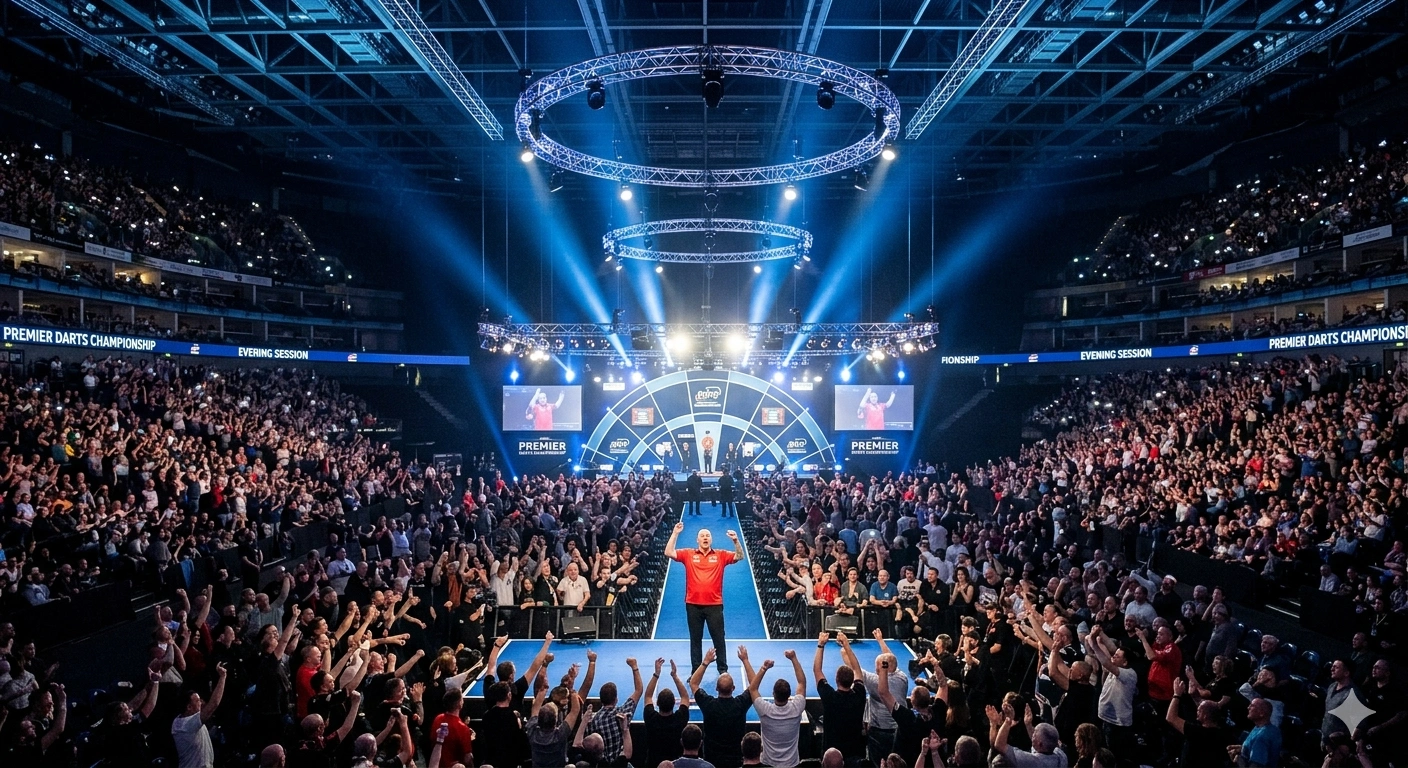
Nathan Aspinall is one of the most recognisable faces in PDC. A two-time major tournament winner and regular in the Premier League Darts, he drags with him a reputation that goes far beyond his performances on the oche: that of the player who hates his own entrance song.
In an interview with the Double Tops Podcast, 'The Asp' delivered a version of himself as straightforward as it was disconcerting - between his frankly ambiguous relationship with Mr. Brightside of the Killers, his assumed plan to switch to Eminem's Lose Yourself in his final season, and a vision of darts firmly focused on financial security rather than sporting glory.
Mr. Brightside: the anthem he's endured for ten years
The scene is familiar to all darts fans. The first notes of Mr. Brightside ring out across a large arena, and thousands of spectators are singing along to the Killers' chorus before Aspinall even sets foot on stage. For the audience, it's a moment of communion. For him, it's a form of gentle torture.
I may be called Nathan Aspinall, but when I walk down the street it's 'oh, Mr. Brightside'. It pisses me off.
The phrasing is clear, unambiguous. There is no false modesty in 'The Asp'. He openly assumes his annoyance, while acknowledging that the song has taken on a dimension that now eludes him.
"Everyone absolutely loves it and it's part of the darts now." This sentence sums up the paradox in which he finds himself trapped. The song is no longer just his - it belongs to the public, the arenas, the atmosphere of the sport. To withdraw it would almost be a betrayal of the fans.
"I've kept it in the top 40 for ten years"
Aspinall is not one to complain without a touch of humour. On the Double Tops Podcast, he dropped this line with a smile: "I've kept him in the top 40 for ten years. You know what I mean?" A way of acknowledging, ironically, the commercial impact that his repeated entries into Europe's biggest cinemas have had on the Killers' career.
This is no harmless quip. Walk-on songs in professional darts have real cultural resonance. Mr. Brightside is regularly listed among the most streamed songs in the UK on big PDC tournament nights. The link between the song and the player has become so strong that it generates exposure for both parties - even if the player himself would happily do without it.
The iconic walk-ons you can't change
Aspinall is clear-eyed about the hierarchy of walk-ons song in the darts world. He cited several examples of songs that are so integral to a player's identity as to become untouchable.
Michael van Gerwen - Seven Nation Army, one of the most electrifying entries on the PDC circuit
Phil Taylor - a legendary entry that spanned two decades of dominance
Raymond van Barneveld - a unique atmosphere in Dutch venues
Gary Anderson - a walk-on that accompanies every appearance of the 'Flying Scotsman'
Adrian Lewis - a sonic identity built on years of competing at the highest level
"There are certain walk-ons that are iconic. Obviously Michael's, Phil's, Barney's, Gary Anderson's, Adrian Lewis' - there are some you can never change." And he reluctantly puts his in that category.
Lose Yourself: the plan for the home stretch
The promise is formal. When the final year of his PDC career comes, Nathan Aspinall will march to the oche on Eminem's Lose Yourself. "I can't change it until it's my last year, and I'll change it to Lose Yourself. Yeah, a thousand percent."
He hasn't waited in vain. He's already tested the transition twice. At the German Darts Grand Prix 2024, en route to the title, he used Lose Yourself before his semi-final against Kevin Doets. The previous year, at the German Darts Championship, he made the same choice for a first-round 6-3 win over Maximilian Czerwinski. Both tests were successful from a sporting point of view. The verdict on the atmosphere in the halls? That's an open question.
The choice of Eminem is not insignificant. Lose Yourself is a song about seizing an opportunity, about the pressure of the decisive moment, about total concentration in the face of what's at stake. Thematically, it's perhaps the song that best fits Aspinall's playing philosophy - a player known for his mental toughness in critical moments. But replacing Mr. Brightside also means severing an emotional link with thousands of fans who associate the tune with unforgettable evenings.
The weight of tradition in PDC walk-ons
In major PDC tournaments - World Championship at Alexandra Palace, Premier League in European arenas, Masters, Irish Grand Prix - walk-ons are much more than a formality. They are rituals. Organisers and broadcasters integrate these moments into the narrative of the show.
Changing the entrance song after a decade represents a real risk in terms of connecting with the audience. Lukáš Klečka, Peter Wright with his extravagant costumes and Snap, or Gerwyn Price and his dramatic entrance stances - each player has built a stage identity that fans recognise immediately. Aspinall knows this better than anyone. That's precisely why he waits until his final season to make the change: at that point, the normal rules no longer apply.
Darts as work, not romantic passion
The podcast's second revelation is perhaps the most surprising for those who project an idealised view of professional sportspeople's relationship with competition. Nathan Aspinall has made no secret of his priorities: he plays darts for money.
"I don't care about trophies," he said. "I do this game because it's my job and I never want me or my kids to have to worry about money." The wording is direct, almost brutal in its frankness. It breaks with the usual discourse of sporting champions, who systematically evoke passion, dreams and glory.
A family vision of professional success
Aspinall places his family's financial security above all else. This is not a posture. It's a structuring priority that explains his choices - his regularity on tour, his presence in as many tournaments as possible, his professional approach to preparation.
Honestly, I don't care about trophies. Of course, I want to win tournaments and I'd be delighted to add another trophy to my trophy cabinet. But for me, it's really about trying to win as much money as I can over the next ten years.
This statement is not an invitation to play down his performances. It contextualises them. Aspinall has won the UK Open in 2019 and the US Darts Masters - two major tournaments on the PDC calendar. He has played in several Premier League finals. His place among the world's elite is established. But the engine that drives him to train, to travel, to maintain his level over time, is economic stability for his people.
A pragmatism that contrasts with dominant narratives
In the world of darts, dominant narratives often revolve around pure passion. Luke Littler who started playing as a child and became world number one at 17. Michael van Gerwen, who says he wants to be the best player of all time. Peter Wright who invests in his extravagant outfits to create a memorable stage persona.
Aspinall embodies another reality of professional sport: that of the practitioner who does his job with excellence, without trying to feed a myth. This is no less respectable. In fact, in some ways, it's more honest.
Aspinall embodies another reality of professional sport: that of the practitioner who practises his craft with excellence, without trying to fuel a myth.
PDC has transformed darts into an industry capable of generating significant revenue for its top players. Prize money at major tournaments has exploded over the last fifteen years. The World Championship at Alexandra Palace now has a total prize money of several million pounds. In this context, it would be strange for a player of Aspinall's level not to consider the financial aspect as a central dimension of his career.
The profile of a player who has it all figured out
What this interview reveals is a Nathan Aspinall with a clear awareness of who he is, what he wants, and how long he has to get it. He speaks of "the next ten years" with a lucidity that implies planning. He refers to "his last year" for the walk-on as a stage already anticipated, a precise time horizon in his mental calendar.
This clarity is reflected in his playing. Aspinall is not a spectacular player in the sense that van Gerwen or Littler can be - his averages don't regularly beat 110 points. But he is a consistent player, difficult to beat over time and capable of raising his game in the big moments. His 2019 UK Open victory over Michael van Gerwen in the final remains one of the standout performances of his career.
Year | Tournament | Adversary in final | Score |
|---|---|---|---|
| 2019 | UK Open | Michael van Gerwen | 11-8 |
| 2019 | US Darts Masters | Mensur Suljovic | 8-3 |
These two titles laid the foundations for a career at the top. Consistency in the Darts Premier League - one of the most selective competitions in the PDC calendar - confirms that Aspinall is part of an elite group that organisers see as guarantees of audience and competitive level.
The final year as a symbolic culmination
There is something about the idea of booking Lose Yourself for its final year that is consistent with Aspinall's psychology. It's a calculated, considered move, part of a long-term vision. He's not giving in to the impulse to change now because he knows that the contract with the public has a value. He's honouring that contract to the end, and he's giving himself an out in his own way.
It's also, in a way, a final thumbing of the nose: after years of enduring Brandon Flowers' verses, he'll close his career with Eminem's lyrics. "You only get one shot, don't miss your chance to blow. For a player who defines his success by the financial security he will have built for his family, the message couldn't be more appropriate.
Nathan Aspinall will return to the circuit at the next PDC tournaments of the season. His presence in Premier League Darts, if confirmed for next year's event, will be an opportunity to see if this pragmatic talk translates into an even more methodical approach to the game. The question is not whether he can win a third major title - career data suggests he can. The real question is: what price will he put on that victory?